94%
CONFIDENTIAL BRIEFING // FRONTIER INTELLIGENCE // EYES ONLY
The strategic dependency on proprietary cloud APIs has become a critical single point of failure for enterprise AI initiatives. This report details the emergence of a counter-strategy: sovereign AI agents powered by local Small Language Models (SLMs). The capability to deploy autonomous, reasoning AI agents entirely on-premise, with zero data egress and no recurring API costs, represents a fundamental shift in the AI development landscape. This is not a tutorial; it is a strategic assessment of a disruptive capability now within reach of any competent engineering team.
Strategic Context: The Case for Sovereign AI Operations
The prevailing model of AI agent development has been tethered to the economics and policies of major cloud providers. This introduces three core vulnerabilities: data privacy exposure, unpredictable API costs, and operational fragility in low-connectivity environments. The local AI agent paradigm, utilizing sub-10B parameter SLMs, directly mitigates these risks. Key entities enabling this shift include Ollama for model orchestration and LangChain/LangGraph for agentic workflow construction. The move to local execution is a strategic imperative for sectors handling sensitive IP, financial data, healthcare records, or operating in edge computing and offline AI scenarios.
Technical Deep Dive: Architecting the Sovereign Agent
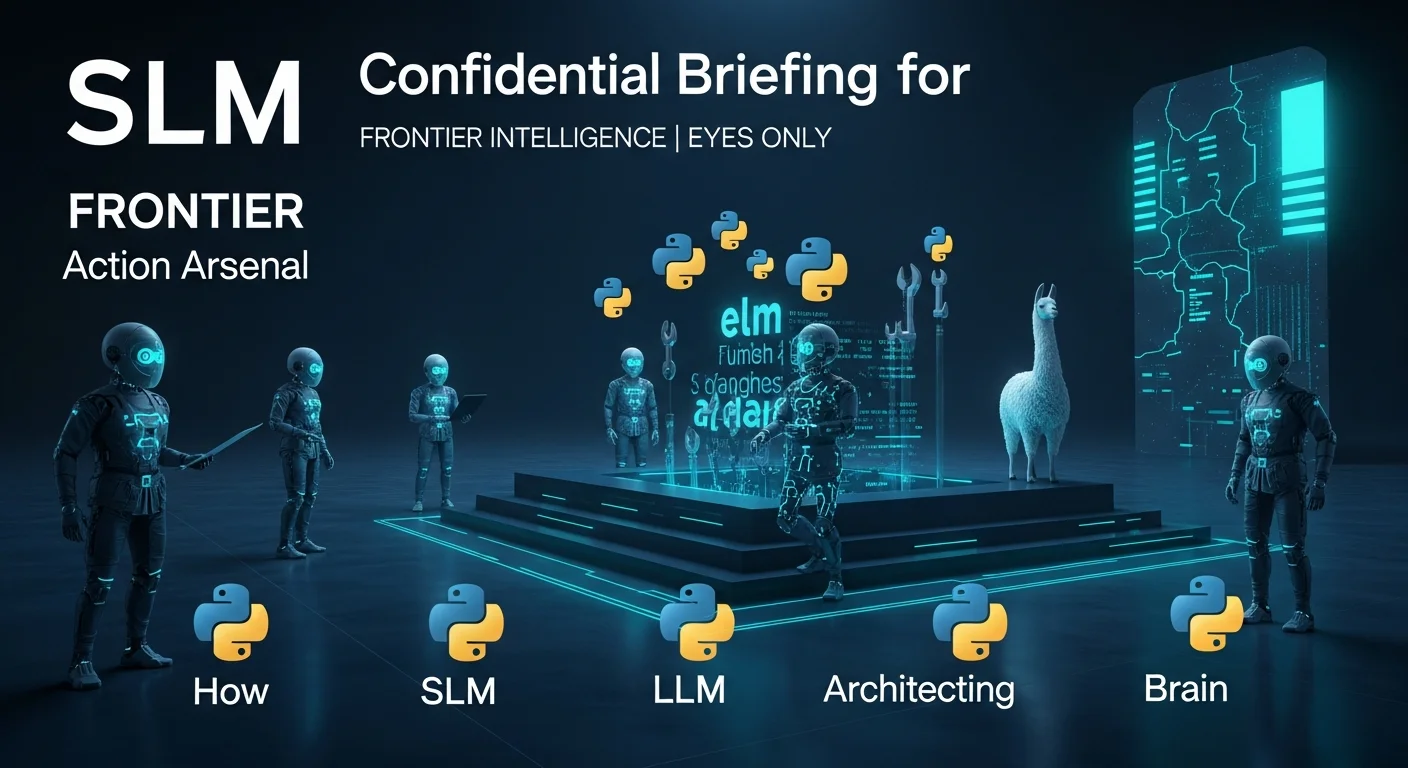
An AI agent, in this context, is defined as a program that utilizes a language model as a core reasoning engine to plan, execute tools, and iteratively achieve a goal. The foundational architecture for a local AI agent consists of three pillars:
- Brain (The SLM): A compact, efficient model like Phi-3, Mistral 7B, or Llama 3.2 running via Ollama.
- Memory (Conversation State): Implemented via frameworks like LangChain‘s ConversationBufferMemory to maintain context across interactions.
- Tools (Action Arsenal): Python functions (e.g., calculators, data fetchers, system controllers) that the agent can call to interact with the external world.
Comparative Analysis: Leading Small Language Models for Local Agents
The selection of the core SLM is a critical performance determinant. The following table provides a tactical comparison of leading contenders for local AI agent deployment.
| Model & Developer | Size (Parameters) | Primary Strengths (Pros) | Operational Limitations (Cons) | Axiom Grade (1-10) |
|---|---|---|---|---|
| Phi-3 Mini (Microsoft) | 3.8B | Exceptional reasoning speed, low memory footprint, strong instruction following. | Smaller context window, less knowledge breadth than larger models. | 9 |
| Mistral 7B (Mistral AI) | 7B | Robust general-purpose performance, excellent open-weight license. | Higher VRAM requirement, slower inference on CPU. | 8 |
| Llama 3.2 3B (Meta) | 3B | Optimized for dialogue, balanced performance per parameter. | Relatively new, smaller community tools. | 8 |
| Gemma 2B (Google) | 2B | Extremely lightweight, ideal for strict hardware constraints. | Significantly reduced reasoning capability on complex tasks. | 6 |
Operational Implementation: From Theory to Local Execution
The transition to a functional local AI agent requires a precise sequence. First, deploy Ollama and pull a target model (e.g., `ollama pull phi3`). Second, establish a Python environment with langchain, langchain-ollama, and langgraph. The core agent assembly utilizes the ReAct (Reasoning + Acting) pattern, facilitated by LangChain‘s AgentExecutor. This creates a loop where the SLM reasons about a query, selects a tool, executes it, and observes the result before proceeding.
Figure 1: Strategic Trade-off Analysis: Local SLM Agents vs. Cloud API Agents
[Bar Chart: Comparative Metrics]
– Data Sovereignty: Local Agents: 100 | Cloud Agents: 30
– Recurring Cost (Scale): Local Agents: 5 | Cloud Agents: 95
– Deployment Latency (Offline): Local Agents: 10 | Cloud Agents: 100
– Peak Reasoning Accuracy: Local Agents: 65 | Cloud Agents: 90
– Operational Control & Customization: Local Agents: 95 | Cloud Agents: 40
Analysis: The chart quantifies the non-negotiable advantages of local AI agents in sovereignty and cost, against the acknowledged performance lead of frontier cloud models in complex reasoning tasks. The choice is strategic, not absolute.
The Axiom Take: Strategic Verdict for Frontier Intelligence
The democratization of local AI agent development is not a marginal trend; it is a structural correction in the AI industry. We predict a rapid bifurcation: cloud APIs will continue to dominate for applications requiring maximum reasoning power, while a massive long-tail market for private, specialized, and cost-sensitive AI agents will be captured by SLM-based local deployments. Investment should flow towards: 1) companies optimizing SLM inference efficiency, 2) developer tools (like LangGraph alternatives) simplifying local agent orchestration, and 3) vertical SaaS built atop sovereign agent stacks. The era of the offline AI co-pilot is imminent. Engineers and decision-makers must build competency in this stack immediately or cede strategic autonomy.
Frequently Asked Questions (FAQ)
What are the minimum hardware requirements to run a useful local AI agent with an SLM?
A modern multi-core CPU (e.g., Intel i5/i7, Apple M-series) with 16GB of RAM is sufficient for CPU inference of models like Phi-3 Mini or Llama 3.2 3B, yielding usable response times (5-15 seconds). For performance akin to cloud APIs, a consumer GPU (NVIDIA RTX 3060/4060 with 8-12GB VRAM) is recommended, enabling sub-second token generation for 7B-parameter models and smooth multi-agent workflows.
How does the reasoning capability of a local 7B SLM agent compare to GPT-4 or Claude 3?
For well-defined, tool-augmented tasks (data analysis, controlled document Q&A, simple planning), a properly prompted local agent with a 7B SLM can achieve 80-90% of the functional outcome. Its primary deficit is in open-ended, creative, or deeply multi-step reasoning where larger models excel. The local agent’s strength is reliable, private execution of a defined function, not winning academic benchmarks. For deeper technical comparisons, refer to studies from arXiv on model scaling laws.
Can local AI agents with SLMs be scaled for multi-user enterprise applications?
Yes, but the architecture shifts. Instead of scaling the model, you scale the agent instances and the tool backend. A single server can host multiple Ollama instances of the same lightweight SLM, each serving a stateless agent process. The state and memory are managed externally (e.g., in a database). This allows hundreds of concurrent, simple agent interactions, making it viable for internal helpdesks, data entry automation, or personalized document assistants within a secure perimeter.