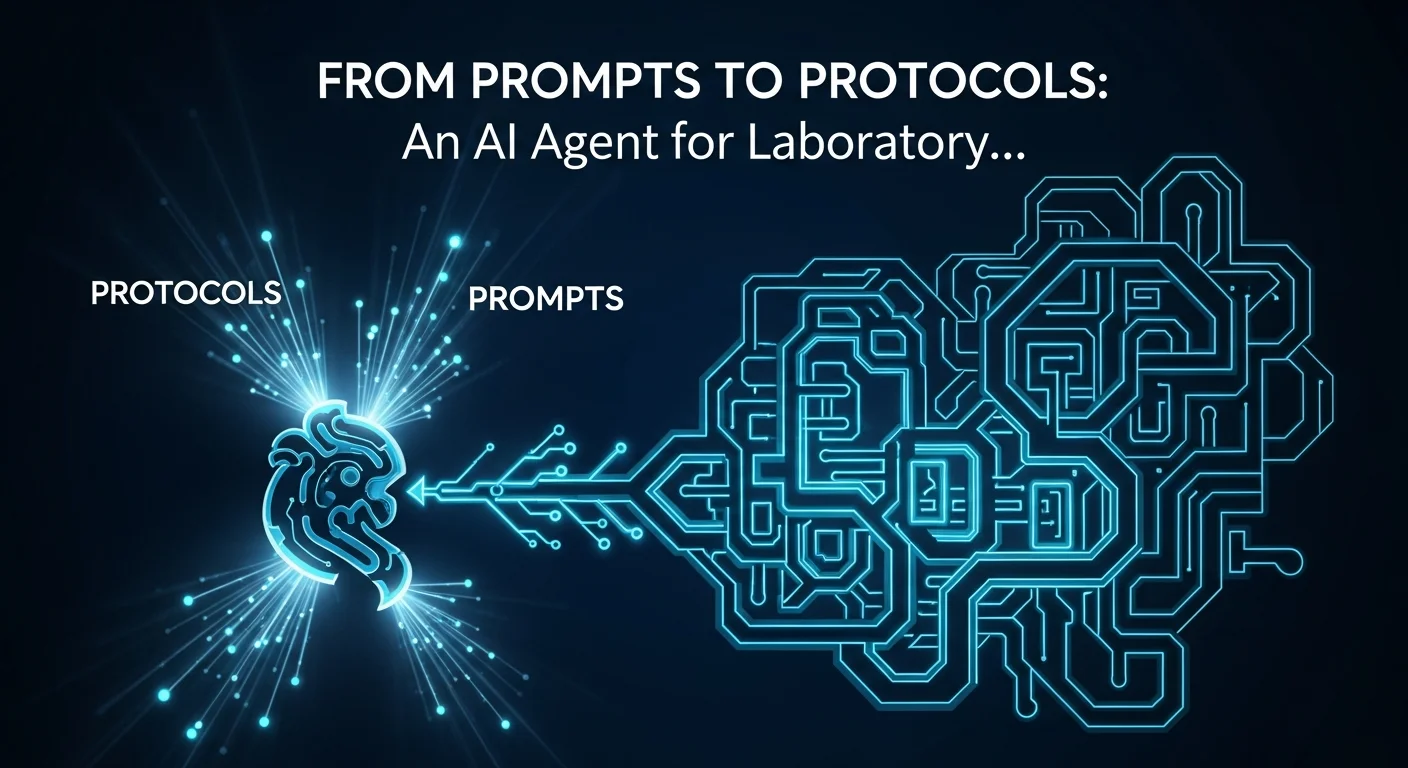
[2605.16552] From Prompts to Protocols: An AI Agent for Laboratory Automation
2 min read
Furthermore, scientists spend too much time managing complex lab software and instruments. Moreover, this new AI system lets them use simple, everyday language to create and run experiments. Consequently, it handles the tricky coding and coordination for them.
Specifically, the AI agent works inside a lab management system. Additionally, it includes a visual tool that turns protocols into easy-to-understand diagrams. Thus, this makes science faster and more accessible for everyone.
| Aspect | Traditional Laboratory Automation | AI Agent (EOS) Approach |
|---|---|---|
| Protocol Creation | Requires writing code and managing complex configuration files manually | Interactive natural language prompts; 97% first-attempt protocol generation success rate |
| Error Handling | Manual debugging and configuration by scientists; time-consuming | Agentic loop with automated validation and error correction built in |
| User Interface | Command-line and scripting-based; steep learning curve | Visual graph editor with node-based diagrams synchronized with AI agent’s protocol representation |
| Optimization Campaigns | Requires separate scripting for closed-loop experimentation | Native support for running and monitoring closed-loop optimization campaigns via natural language |
| Accessibility & Actions | High number of interface actions; domain expertise in software required | Order of magnitude reduction in required interface actions; scientists interact conversationally |
AI Agent for Laboratory Automation
Notably, this AI agent lets people create lab protocols using natural language. Consequently, they no longer need to write complex code. Therefore, it greatly increases the accessibility of lab automation. Moreover, everyone can focus more on the science itself.
Faster Scientific Discovery
“We present an AI agent architecture that integrates large language models with laboratory orchestration, enabling
Ultimately, this work demonstrates a major step forward in accessible lab automation. In conclusion, the AI agent simplifies complex workflows for everyone. Looking ahead, this approach can accelerate scientific progress. As a result, more people can contribute to research. Therefore, it fosters a more inclusive and efficient future for science.
Ultimately, this AI agent makes lab automation accessible to all scientists. In conclusion, its 97% success rate shows strong reliability for creating protocols. Therefore, this approach can greatly speed up research across many fields.
Thus, it shifts the focus from complex coding to simple conversation. Consequently, scientists can spend more time on discovery and less on setup. As a result, the agent lowers barriers for more people to do advanced experiments. Accordingly, this work points toward a future where labs are more inclusive and efficient.