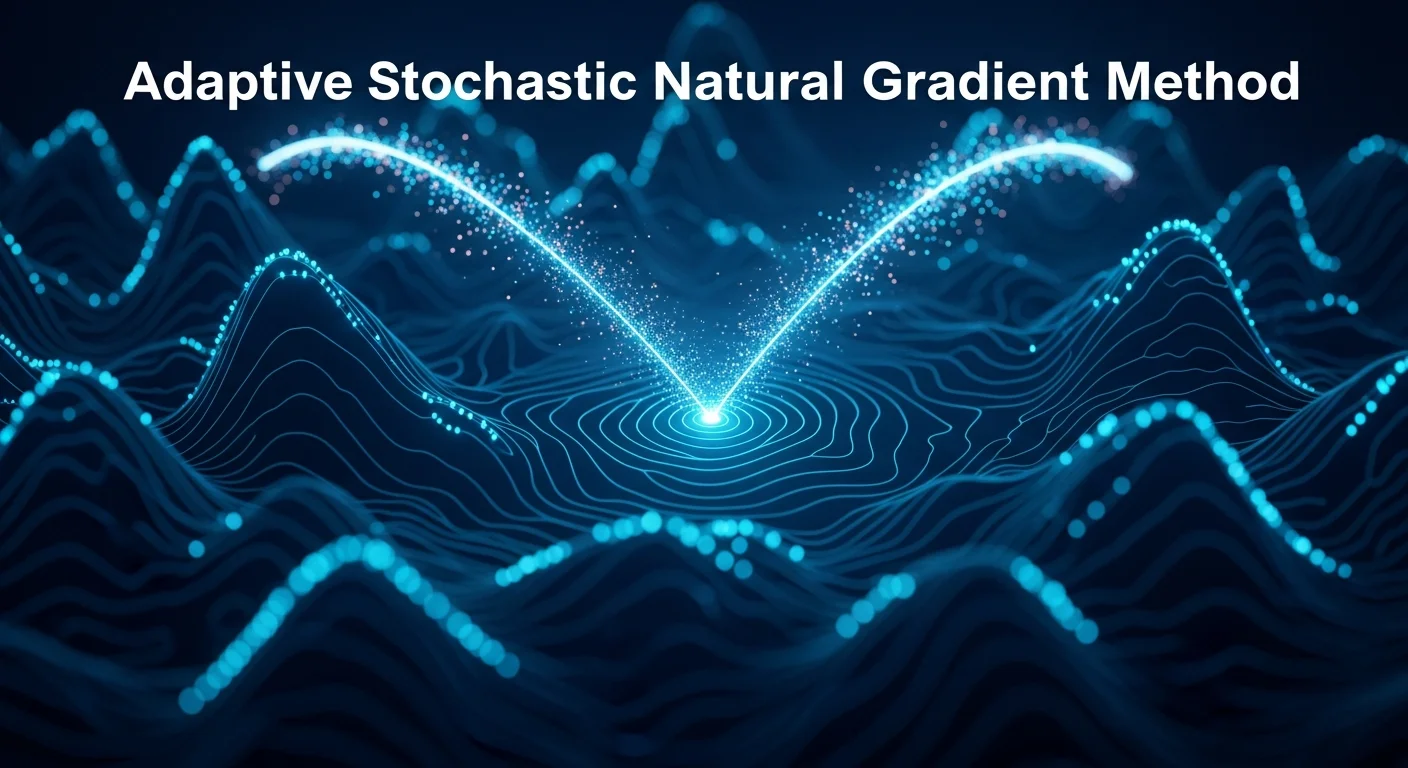
[2605.17925] Adaptive Stochastic Natural Gradient Method for Safe Optimization on Binary Space
2 min read
Furthermore, many real-world optimization problems, like in medicine or engineering, carry risks. Consequently, testing a bad idea can be unsafe. However, safe optimization helps find good answers while avoiding these dangers.
In particular, solving this for binary space (yes/no choices) is hard. Therefore, researchers created a new tool called safe ASNG. Specifically, it learns a safe zone around known good ideas. Thus, when it explores, it only tests new ideas inside this safe zone, preventing dangerous mistakes.
| Feature | Safe ASNG (Proposed) | Standard ASNG | Continuous Safe Optimization |
|---|---|---|---|
| Search Space | Binary space (Bernoulli distributions) | Binary space (Bernoulli distributions) | Continuous space |
| Safety Mechanism | Estimates Lipschitz constants via Hamming distance using discrete Walsh function surrogate models; projects solutions to nearest safe region | None — evaluates all generated solutions regardless of safety | Surrogate-based safety models on Euclidean distance; safe region projection |
| Unsafe Evaluation Suppression | Effectively suppresses unsafe evaluations throughout optimization | Fails to suppress unsafe evaluations — may evaluate high-risk candidates | Suppresses unsafe evaluations but not directly applicable to binary domains |
| Optimization Efficiency | Maintains efficient convergence while enforcing safety constraints | Efficient convergence but with no safety guarantees | Efficient in continuous domains but incompatible with binary Hamming distance metrics |
| Distance Metric | Hamming distance (discrete) | N/A (no safety-aware distance) | Euclidean distance (continuous) |
Safe Optimization on Binary Space
In addition, safe optimization often overlooks binary search spaces, where risk is common. Consequently, the safe ASNG method estimates safety limits using Lipschitz constants and Walsh functions. As a result, it defines a safe region around known good points. Therefore, it projects new solutions into this region to keep everyone safe. Notably, experiments show it works better and safer than other methods for people.
Enabling Safer AI in Discrete Domains
“This paper has been accepted as a full paper at GECCO2026.”
Ultimately, this paper presents a novel method for safe optimization in binary search spaces. Therefore, Safe ASNG uses discrete Walsh functions to model safety constraints and projects solutions into safe regions. Consequently, it successfully suppresses unsafe evaluations while maintaining optimization efficiency.
In conclusion, this work addresses a critical gap in applying safe optimization to discrete domains. Thus, it offers a promising tool for risk-sensitive applications in medicine and engineering. Accordingly, future research can build upon this foundation to enhance safety guarantees for complex real-world problems.