
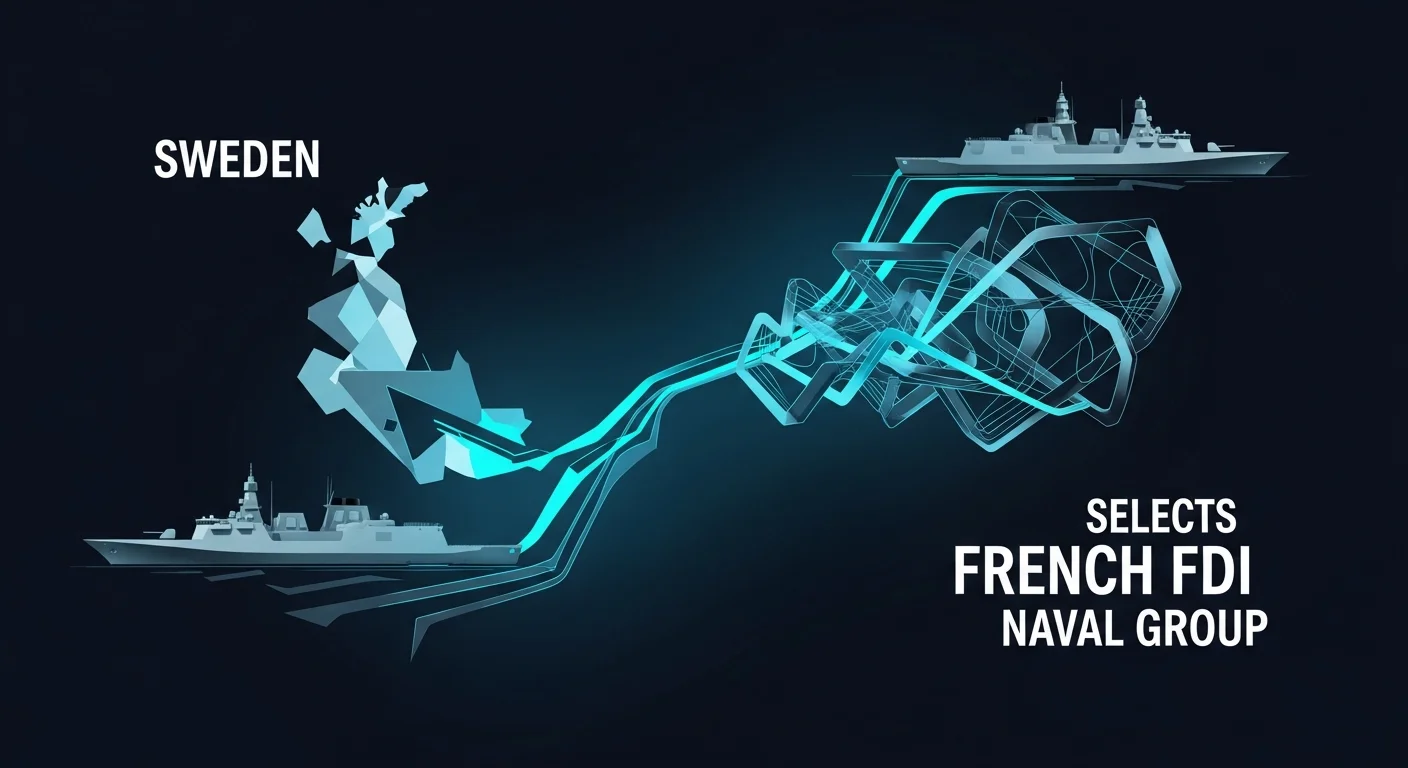
Sweden selects French FDI frigates from Naval Group – Breaking Defense
3 min read
Specifically, these are powerful FDI frigates. Consequently, they will greatly improve Sweden’s defense against missiles and drones. Additionally, the first ship will be ready in 2030.
| Criteria | France — Naval Group FDI | UK/Sweden — Babcock & Saab Arrowhead 120 |
|---|---|---|
| Design Status | Already in production; lead ship (Amiral Ronarc’h) delivered to French Navy in Oct 2025 with validated digital architecture and combat systems. | Newly developed Luleå-class design based on enlarged Arrowhead 120; not yet in production at time of selection. |
| Air Defense Capability | Integrated, combat-proven system: 32-cell Sylver A50 VLS with MBDA Aster 30 (ballistic missile intercept capable) plus MBDA CAMM-ER for medium-range defense. | Details not finalized; design sized (122 m) to accommodate VLS-based air defense but no equivalent combat-proven integrated suite confirmed. |
| Delivery Timeline | Fast delivery: first ship expected in 2030, one per year thereafter. Government cited speed as a key selection factor given current security situation. | Longer lead time expected; design still in definition phase at time of cancellation of earlier Visby Gen 2 program in 2023. |
| Domestic Industry Role | Swedish subsystems integrated: Saab RBS 15 missiles, Torpedo 47, GIX radars, Trackfire RWS, BAE Bofors 57 mm & 40 mm guns. | Larger domestic prime-contractor role for Saab Kockums, continuing Sweden’s centuries-long tradition of indigenous warship development. |
| Geopolitical Alignment | Strengthens European (French-Italian) defense industrial cooperation; France is not a member of the UK-led JEF. | Aligned with UK-led Joint Expeditionary Force (JEF) membership; Saab’s direct involvement as domestic partner. |
Sweden Picks French FDI Frigates
Consequently, Sweden chose the French FDI frigates to strengthen its naval defense. As a result, this marks a major geopolitical shift from traditional domestic production. Therefore, the ships will provide everyone with advanced air defense capabilities. Similarly, this aligns with their new role in NATO. Moreover, the decision highlights a move toward integrated European security for all people.
Enhanced Air Defense for Sweden
“We have seen that Russia has increased its production of ballistic missiles over the past year. Our capability in this area [air defence] will triple with this acquisition.”
Ultimately, this decision marks a significant shift for Sweden. In conclusion, it selects a proven, combat-ready design. Looking ahead, the frigates will triple air defense capability. As a result, Sweden’s naval power strengthens. Therefore, it aligns with NATO needs. Thus, delivery begins in 2030. Hence, a new era starts. In summary, it’s a major step. To conclude, this enhances regional security. Finally, it reflects a modern strategic choice. Accordingly, the fleet’s future is secure.
Next-Gen Naval Tactical Systems
Unmanned Systems Integration in Modern Frigates
Advanced Ballistic Missile Defense Technology
Ultimately, this decision strengthens Sweden’s naval defense within NATO. In conclusion, choosing the French frigate offers a proven, fast solution for current security needs. Therefore, it marks a practical shift toward integrated European defense cooperation. Thus, Sweden enhances its regional stability and collective security role.
Consequently, the move balances national tradition with alliance requirements. As a result, it ensures advanced air defense for the future. Accordingly, this acquisition prioritizes reliable capability and delivery. In summary, it aligns Sweden’s navy with modern NATO operational demands.