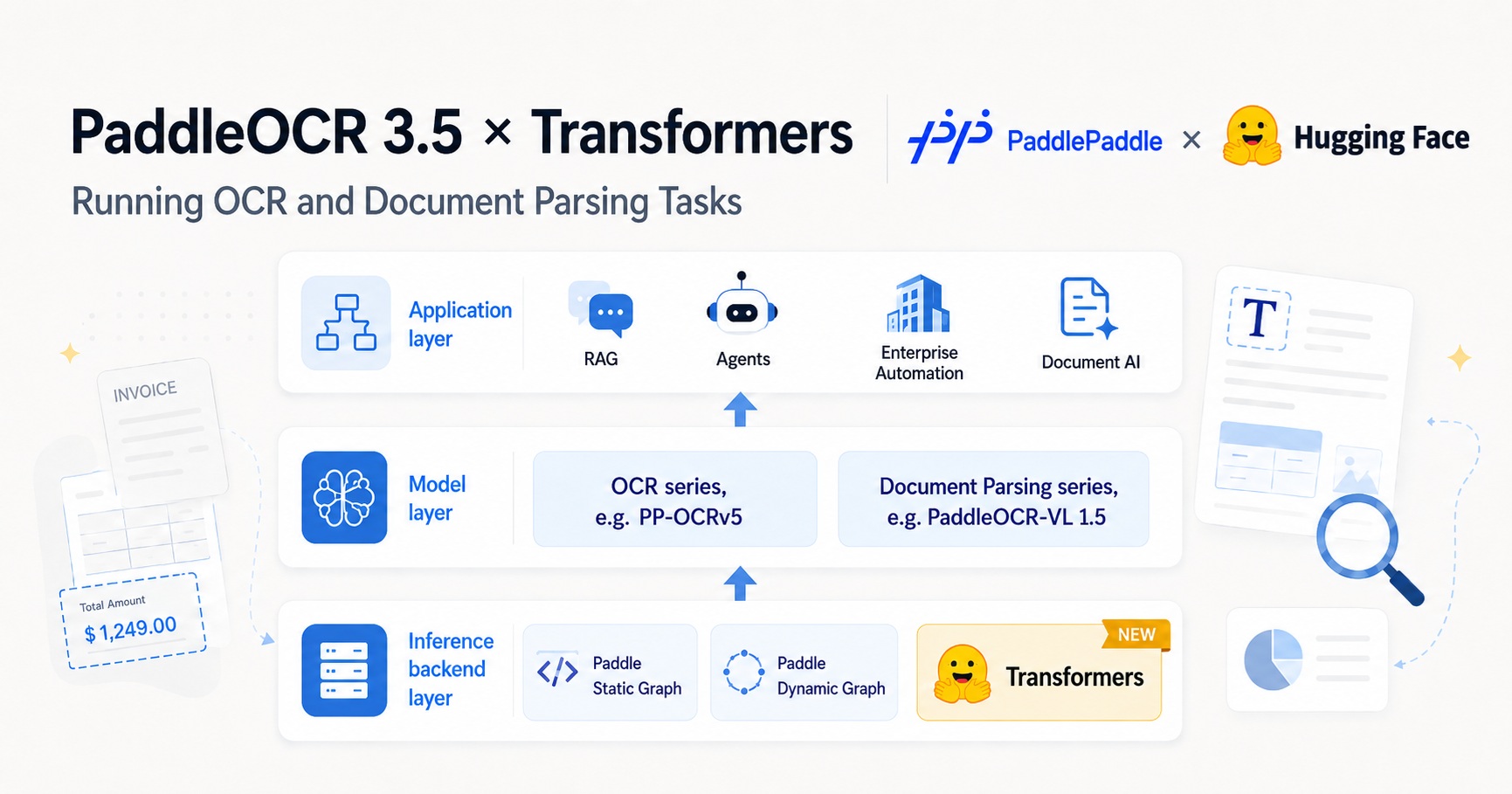
PaddleOCR 3.5 Bridges OCR with Transformers, Supercharging Document AI for RAG
2 min read
Moreover, developers can choose the engine parameter that fits their project. In addition, this means their tools can work better with the Hugging Face ecosystem. Similarly, this makes building RAG applications smoother.
Consequently, this update offers more flexibility. Therefore, teams can build smarter document AI workflows with less friction. Ultimately, it helps everyone use the best tools for their specific task.
| Aspect | Previous Versions (Pre-3.5) | PaddleOCR 3.5 (With Transformers Backend) |
|---|---|---|
| Primary Inference Backend | PaddlePaddle static graph (paddle_static) and dynamic graph. | PaddlePaddle backends remain, but a new engine="transformers" option is added, using Hugging Face Transformers as a runtime. |
| Ecosystem Integration | Primarily integrated within the PaddlePaddle ecosystem. | Deep integration with the Hugging Face ecosystem: model discovery on the Hub, use of Transformers’ API patterns, and compatibility with PyTorch/Transformers infrastructure. |
| Configuration Flexibility | Backend-specific configuration through PaddlePaddle parameters. | A new, unified engine_config parameter allows developers to set Transformers-specific options like dtype, attn_implementation, and device placement. |
| Recommended Use Case | Best for maximizing OCR/document parsing throughput and performance in production pipelines. | Best for teams already using a Hugging Face/PyTorch stack, for RAG/Document AI prototyping, and for easier integration into existing Transformers-based services. |
PaddleOCR 3.5 with Transformers
In addition, PaddleOCR 3.5 now works with a Transformers backend. Consequently, people can use its document tools within the Hugging Face ecosystem. Similarly, this gives everyone more choice in how they run tasks. Therefore, developers have an easier path for building RAG and other Document AI applications. Moreover, the community benefits from greater flexibility and simpler integration.
Bridging OCR and Transformers Ecosystem
“This release is not about replacing one backend with another. It is about giving developers more flexibility: use PaddleOCR for OCR and document parsing capabilities, and choose the inference backend that best fits your stack.”
Ultimately, PaddleOCR 3.5 offers powerful document understanding tools. Therefore, developers gain flexible integration with the Transformers backend. Looking ahead, this collaboration will inspire more open AI solutions. Hence, creating better, more accessible technology for everyone is the shared goal.
Ultimately, PaddleOCR 3.5 simplifies integrating document intelligence into modern AI workflows. In conclusion, this update directly supports developers working within the Hugging Face ecosystem.
Therefore, teams can build powerful RAG and Document AI applications with less friction. Thus, the release strengthens the connection between powerful OCR models and popular machine learning frameworks. Consequently, it offers valuable flexibility for diverse project needs.