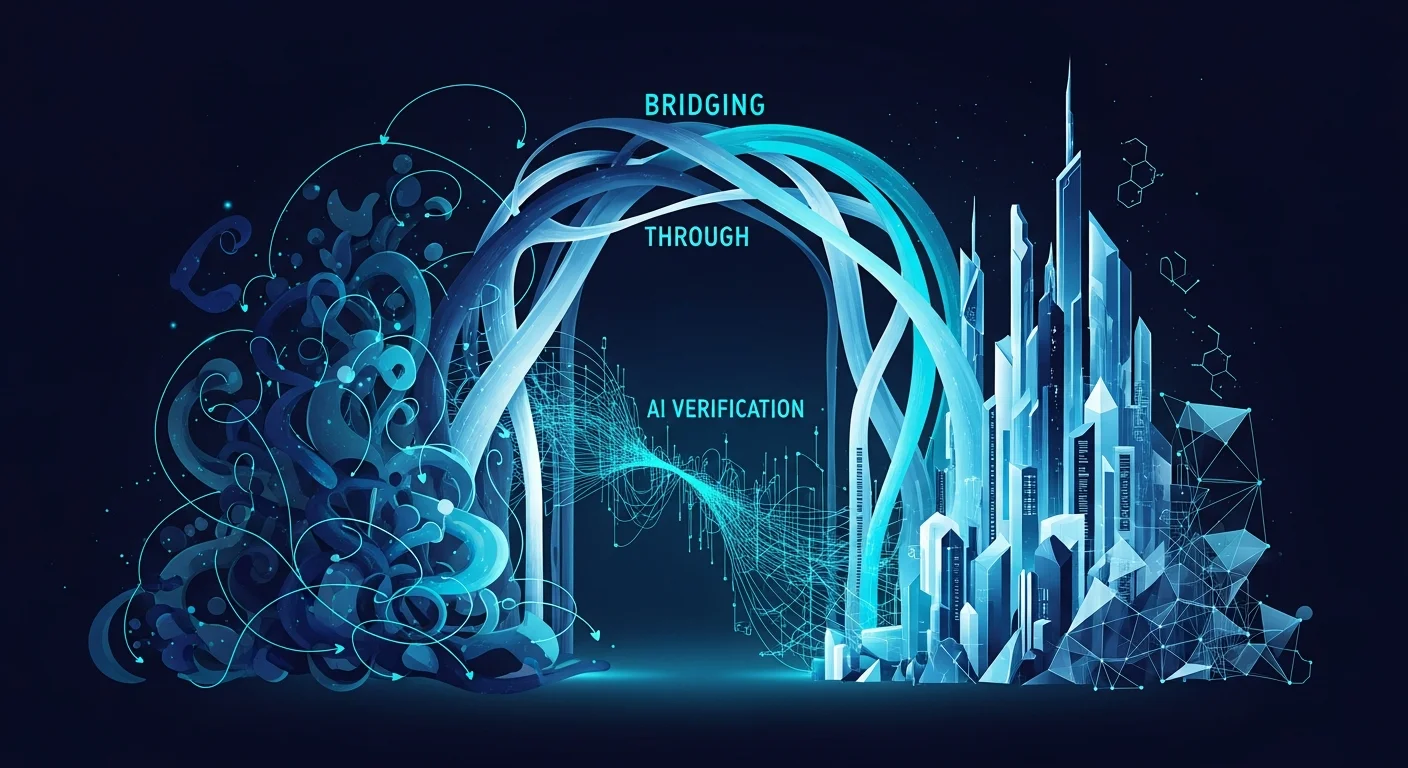
Bridging Natural Language and Formal Logic Through AI Verification
2 min read
Certainly, translating everyday language into precise computer rules is difficult. Basically, it needs experts to write them, which limits who can use it. Furthermore, current computer methods can sound fluent but often make mistakes.
Therefore, researchers created NeuroNL2LTL, a new neurosymbolic framework. Specifically, it combines learning from data with formal verification. Importantly, this system checks its work and learns from its errors to improve.
Consequently, this approach helps translate requirements into Linear Temporal Logic more reliably. Moreover, it can explain its answers, letting experts validate the results. Ultimately, this builds more trustworthy tools based on logical guarantees.
| Aspect | Details | Significance |
|---|---|---|
| Core Challenge | Translating between Natural Language (NL) and Linear Temporal Logic (LTL) for safety-critical systems. | Limits formal verification’s reach due to required expertise; existing methods trade expressiveness for reliability or fluency for correctness. |
| Core Innovation | Verifier-in-the-loop training: Uses formal verification outcomes as reward signals for reinforcement learning. | Neural components are optimized directly for formal correctness, merging learned translation with logical guarantees. |
| Architecture & Output | Neurosymbolic framework using a structure-preserving intermediate representation with repair mechanisms. | Ensures high correctness: 86% of outputs are verified satisfiable, enabling reliable downstream tool integration. |
| Performance & Scale | Tested on 200,000+ requirements across 10+ domains (aerospace, robotics, etc.). | Achieves 28% semantic equivalence with reference specifications, demonstrating broad applicability and practical effectiveness. |
Linear Temporal Logic Translation
In addition, NeuroNL2LTL uniquely unites neural learning with formal logic for translating natural language to Linear Temporal Logic (LTL). Consequently, it addresses a key gap in safety-critical fields where people need reliable yet expressive specifications. Moreover, the framework uses an intermediate representation to preserve structure. Furthermore, it applies verifier-in-the-loop training, where a repair mechanism corrects near-misses. As a result, the system ensures 86% of outputs are formally satisfiable, enabling everyone to build trustworthy tools.
“This work demonstrates that formal verification can function as both training objective and runtime filter for neural specification systems, allowing us to build neural-based tools whose reliability derives from logical guarantees rather than statistical confidence.”
Ultimately, this neurosymbolic framework offers a significant advance in formal verification. In conclusion, it effectively merges neural fluency with logical guarantees. Therefore, it makes high-assurance system design more accessible. Thus, the verifier-in-the-loop training is a key innovation. Consequently, it produces outputs optimized for formal correctness. As a result, reliability is based on strong logical foundations. Accordingly, this approach holds great promise for safety-critical fields. In summary, it represents a practical step toward trustworthy AI tools.