
Galaxy’s Core Enigma: Why the Most Common Planets Have Insides That Defy Earth’s Blueprint
2 min read
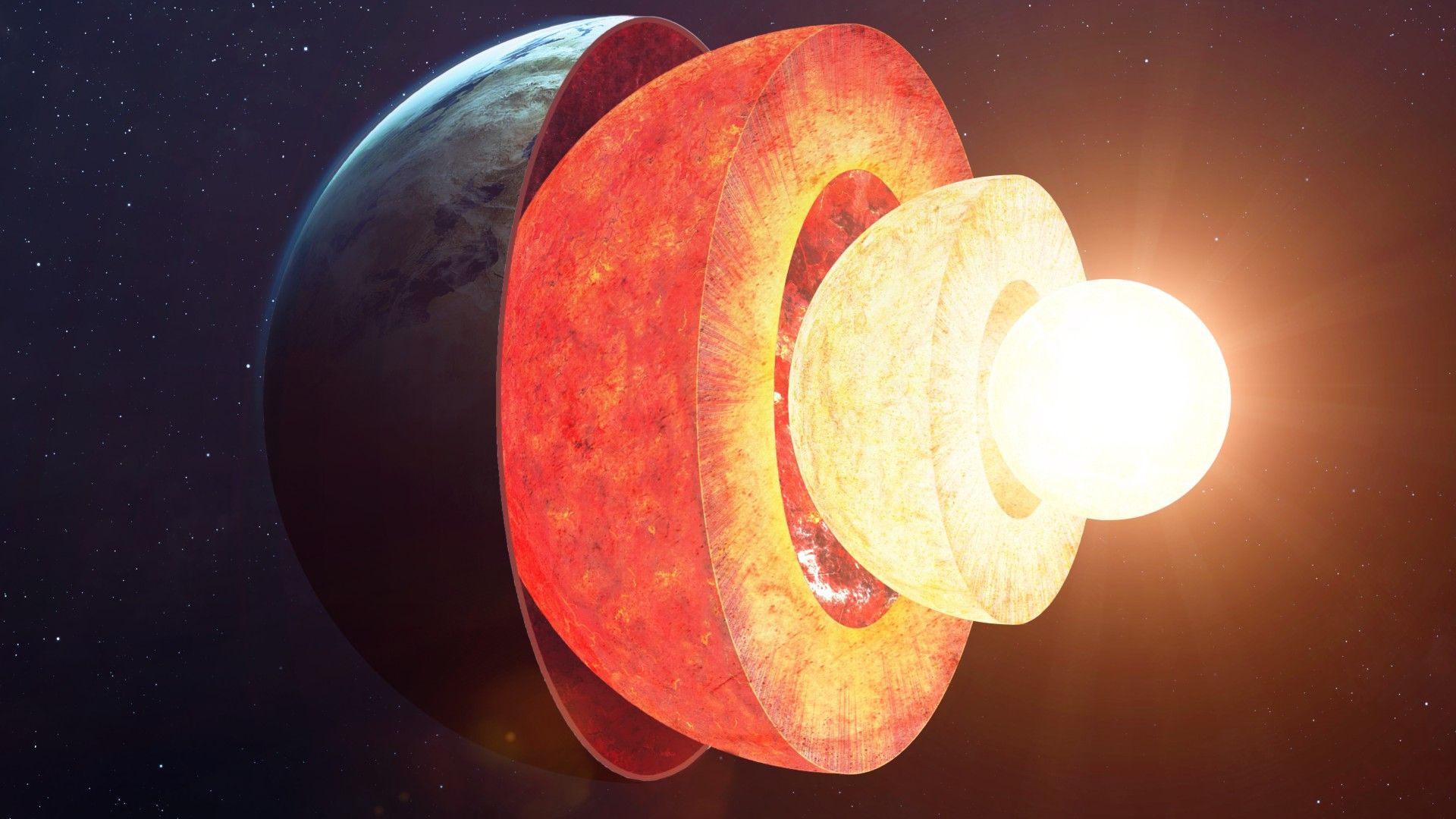
For example, many planets far from Earth may not have a center like our world. However, a new study suggests the most common ones, called sub-Neptunes and super-Earths, could have a very different inside. Importantly, instead of a clear metal core, their insides might be a single, mixed fluid.
Consequently, this new idea helps explain features that old models could not. Similarly, it suggests these planets release gas over time. Essentially, our own planet’s structure might be the unusual one in the galaxy.
| Feature | Earth-like Rocky Planets (< 1% H₂ accreted) | Sub-Neptune / Super-Earth Planets (> 1% H₂ accreted) |
|---|---|---|
| Internal Structure | Clear layered structure: dense metallic core, silicate mantle, thin atmosphere | No distinct core or mantle; homogeneous, churning fluid blend of iron, silicate, and hydrogen all the way down |
| Hydrogen Behavior | Hydrogen remains separate from silicate and iron (like oil and water) | Above ~4,000 K, hydrogen becomes fully miscible with molten silicate — merging into a single fluid phase |
| Atmosphere Evolution | Atmosphere forms early and remains relatively stable | Hydrogen gradually exsolves (“bubbles out”) from the interior over hundreds of millions of years as the planet cools |
| Radius & Cooling Behavior | Predictable contraction and radius evolution matching standard models | Young planets appear “puffier” than expected for their age; models better explain the observed radius gap and orbital-period dependencies |
| Prevalence in the Galaxy | Rare — Earth may be the exception, not the rule | Potentially the most common type of rocky planet in the Milky Way |
Exoplanet Internal Structure Differences
Similarly, most sub-Neptunes may not have an Earth-like planetary core. Consequently, their insides could be a single, miscible mix of materials. In particular, this homogeneous fluid forms under high pressure, eliminating layers. Therefore, everyone should reconsider how these common planets are drawn.
<
A Major Shift in Planet Formation Models
This indicates that sub-Neptune exoplanets, the most common type in our galaxy, may have a homogeneous interior blend instead of a distinct core and mantle. Therefore, our Earth-like model is not the universal standard. Moreover, this new structure explains the observed radius gap in planetary sizes. Consequently, these planets likely cool and contract in a fundamentally different way.
“The familiar concept of a planetary core, a small, dense metallic heart we take for granted, may be the exception rather than the rule for exoplanets.” — Paul Sutter
Ultimately, this discovery challenges our Earth-centered assumptions about planet formation. In conclusion, the most common worlds in the galaxy may have a no Earth-like core. Looking ahead, future telescope observations will test these new models. As a result, we may find that Earth may be the odd one out in the cosmic family.
Ultimately, new research suggests the most common planets in our galaxy, sub-Neptunes, likely lack the distinct core and mantle structure we see on Earth. In conclusion, their interiors may be a single, mixed fluid of hydrogen, silicate, and iron due to extreme conditions.
Therefore, this new understanding helps explain puzzling features in exoplanet data we have observed. Thus, our assumptions about planetary formation need to be more inclusive of this diverse cosmic reality. As a result, Earth’s familiar structure may be less common than we thought.