
Greenpeace underwater robot stages deepest-ever protest on Arctic seabed
3 min read
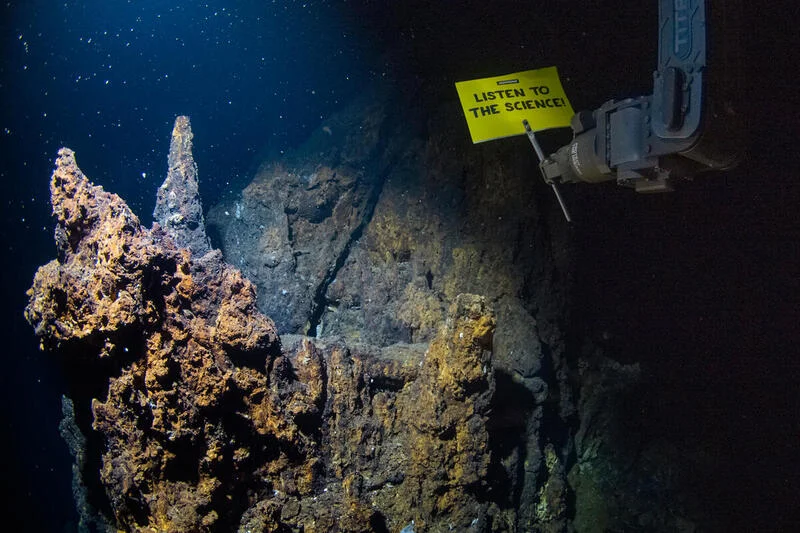
Greenpeace recently used an underwater robot for its deepest-ever protest on the Arctic seabed. Furthermore, they sent a banner over 2,300 meters down to a fragile ecosystem called Loki’s Castle. Consequently, the message “LISTEN TO THE SCIENCE!” reached leaders directly from the deep sea.
Importantly, this unique volcanic site may hold clues to the start of life on Earth. Additionally, it is threatened by plans for deep-sea mining. Essentially, the activists demand leaders protect 30% of the oceans and stop industrial exploitation. Therefore, they are calling for immediate action to safeguard these critical habitats.
| Aspect | Details | Significance |
|---|---|---|
| Protest Depth | Banner deployed at 2,315 metres below sea level via ROV Holly | Deepest seabed banner protest in history, surpassing any previous activist demonstration at ocean depth |
| Location – Loki’s Castle | Hydrothermal vent field with black smokers emitting 300–320 °C fluid from within the ocean crust | Considered a “cradle” of complex life where Earth’s distant ancestors may have originated — scientifically irreplaceable |
| Technology Used | Remotely Operated Vehicle (ROV) Holly; expedition livestreamed on Greenpeace International’s YouTube channel | Demonstrates how robotics and real-time broadcasting can amplify environmental advocacy to a global audience |
| Threats to the Ecosystem | Norwegian government opened the area for deep-sea mining in 2024; plans later halted after multi-stakeholder protests | Scientists warn deep-sea mining would cause irreversible habitat destruction and possible species extinction |
| Policy Demands | Implement the UN Ocean Treaty to protect 30% of oceans by 2030; establish an immediate moratorium on deep-sea mining | Aligns with existing global climate targets — leaders must convert promises into enforceable ocean sanctuary protections |
Greenpeace Underwater Robot Protest
Similarly, the underwater robot protest shows how technology can give a voice to fragile deep-sea ecosystems. Moreover, using science to demand action reminds everyone that leaders must keep their promises. Furthermore, deep-sea mining threatens species that could teach people about life’s origins. In particular, the Arctic faces rapid change, and everyone deserves its protection. Therefore, combining robotics with activism can help them safeguard oceans for future generations.
Deep-Sea Mining Implications
“World leaders have already promised to protect 30 percent of the oceans, now they must listen to the science and actually do it.”
Ultimately, this deepest-ever protest highlights the urgent need to protect our oceans. In conclusion, world leaders must listen to the science and act now. Looking ahead, we must create ocean sanctuaries and stop deep-sea mining. As a result, we can protect vital ecosystems. Therefore, everyone has a role in ensuring a healthy future for our planet.
Ultimately, this protest shows that technology can give a powerful voice to our planet’s most fragile places. Therefore, world leaders must honor their promises to protect oceans and stop deep-sea mining before irreversible harm is done. Accordingly, science-based action is the only path forward.
Thus, using robots to raise awareness sets a bold example for how innovation and activism can work together. Consequently, protecting deep-sea ecosystems benefits everyone on Earth. In summary, we all share responsibility for keeping our oceans safe for future generations.