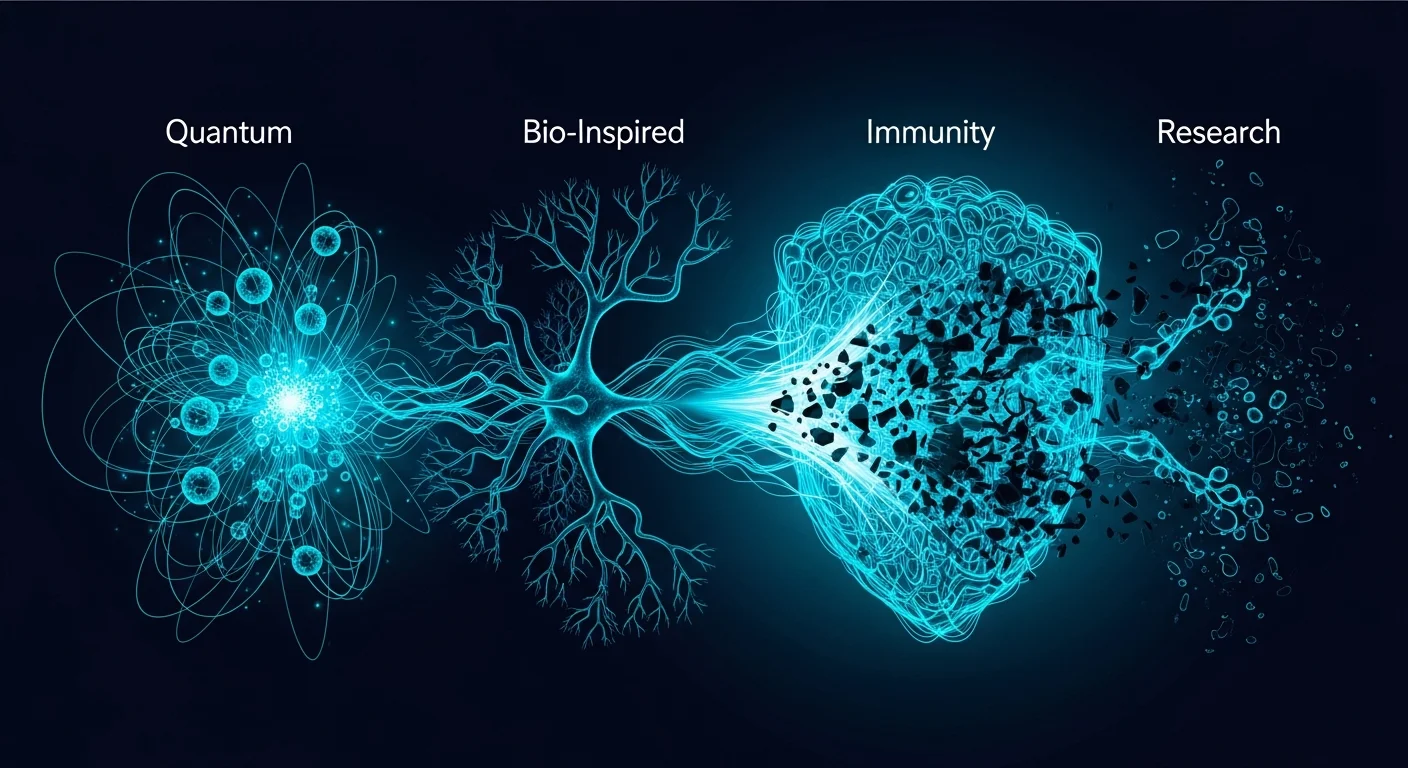
Quantum-Powered Immunity: Transforming Cybersecurity with Bio-Inspired Genetic Algorithms
2 min read
Fundamentally, our immune system learns to spot threats by recognizing what is foreign. Negative Selection Algorithms copy this idea for computer security. However, creating effective digital “detectors” can be slow and difficult.
Consequently, scientists are using quantum computing to help. Specifically, a new method called QGNSA uses a Quantum Genetic Algorithm to build better detectors. Importantly, early tests show it finds anomaly detection with more accuracy. Therefore, this approach could make security systems faster and smarter in the future.
| Feature | Classical NSA Approach | Quantum Genetic NSA (QGNSA) |
|---|---|---|
| Optimization Core | Classical Evolutionary Algorithm | Quantum Genetic Algorithm (QGA) |
| Key Mechanism | Standard genetic operators (crossover, mutation) | Quantum superposition & probabilistic amplitude adjustment |
| Performance Outcome | Standard detection accuracy | Superior anomaly detection accuracy with robustness |
Quantum Genetic Optimization for Anomaly Detection
Notably, this research integrates a quantum genetic algorithm to improve negative selection algorithms. Consequently, the method enhances the search for better detectors. Furthermore, it shows strong anomaly detection accuracy in tests. Additionally, this approach could help everyone protect their data more effectively.
Quantum Advances in Anomaly Detection
This indicates that quantum genetic optimization can improve anomaly detection in negative selection algorithms. Therefore, the QGNSA method uses quantum superposition to explore solutions faster. Moreover, it shows better accuracy than classical methods on financial transaction data. Consequently, this approach helps detect unusual patterns more effectively. Hence, quantum computing offers promising advantages for security applications.
“The most significant near-term quantum advantage will come from hybrid quantum-classical algorithms that leverage the strengths of both paradigms for practical applications like optimization and machine learning.” – Dr. Jay Gambetta, Vice President of Quantum Computing at IBM
Ultimately, this work shows a strong path for improving anomaly detection. In conclusion, the method cleverly combines quantum and biological ideas. Looking ahead, more research on real quantum hardware is needed. Therefore, this progress can help make our digital systems safer for everyone.
Ultimately, this research shows that adding quantum computing principles can make existing immune-inspired algorithms work much better for finding unusual patterns. In summary, the new method finds anomalies more accurately and handles different settings well.
Therefore, this approach offers a promising way to improve security in complex digital areas. Consequently, future work will aim to run it on actual quantum computers and mix it with traditional computing for even greater efficiency.