
Amazon’s Bee wearable raises privacy trade-offs for convenience
3 min read
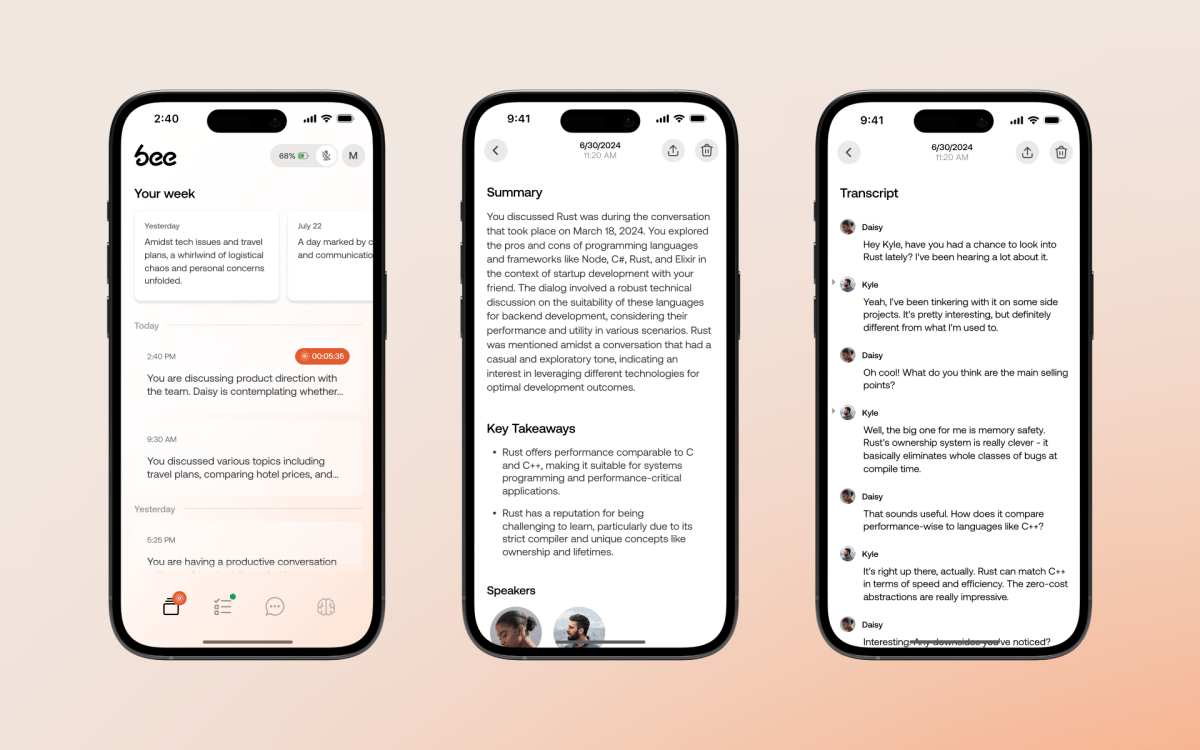
Furthermore, Amazon’s Bee wearable is a new AI assistant that records and summarizes conversations. Additionally, it works like a smart notepad for a user’s daily life. Specifically, it can send calendar reminders and organize meeting notes.
However, the device raises significant privacy questions. Critically, it needs access to a person’s location, photos, and contacts. Consequently, many users may feel uncomfortable with this level of data collection. Therefore, Bee presents a modern dilemma between helpful convenience and personal privacy.
| Aspect | Pros | Cons |
|---|---|---|
| Conversation Recording & Summarization | Automatically records, transcribes, and creates readable summaries of conversations; easy on/off toggle with green light indicator; helps organize meetings and daily life. | Summaries are useful but not markedly different from existing services like Otter or Granola; requires users to manually enter speaker names as Bee can’t always identify who is talking. |
| Transcription Accuracy | Handles context reasonably well — e.g., correctly identified a movie viewing and labeled the summary “Tarantino Film Scene Analysis”; breaks down conversation segments for easy review. | Transcripts can be “a bit of a mess”; omits certain sections of conversations; does not always produce a complete account of what was said. |
| Professional Use Cases | Promising as a meeting assistant for professionals navigating multiple engagements; lets you review summaries without re-listening to entire conversations. | Doesn’t offer a substantially better experience than competing transcription tools already on the market; requires explicit recording consent from all participants. |
| Privacy & Personal Use | Marketed primarily as a personal-life assistant; syncs with calendar, health data, contacts, and notifications for comprehensive life organization. | Requires expansive mobile permissions (location, photos, contacts, calendar, notifications, health data); constant recording raises significant privacy concerns; potentially too invasive for casual or personal settings. |
| Data Security & Storage | Offers encryption at rest and in-transit; claims rigorous third-party security audits and continuous monitoring; demo of fully local processing shown (though not shipped). | All accumulated data is stored in the cloud, raising concerns; no update on local-processing plans; Amazon’s own track record includes occasional data security incidents. |
Amazon Bee Wearable Review
In addition, the Bee wearable shows promise as a professional tool for organizing meetings and tasks. Consequently, its constant recording raises significant privacy concerns for everyone. As a result, people may feel uneasy about the extensive data collection required. Therefore, the device’s value depends heavily on an individual’s comfort with surveillance. Notably, its future success hinges on addressing these security and privacy issues.
Privacy Implications of AI Wearables
This indicates that AI wearables like Bee offer useful professional transcription tools for organizing meetings. Moreover, they raise significant privacy concerns due to extensive data collection. Similarly, users must grant broad mobile permissions for the device to function well. Consequently, personal use feels more invasive than professional applications. Hence, a locally-run version could ease many users’ worries.
“It’s a curious piece of hardware that, given some time and some tweaking, could have some promising professional applications further down the road. As a digital assistant for your personal life, however, it might prove to be a little too invasive for some users.”
Ultimately, Bee shows real promise as a professional tool for busy people. In summary, its extensive data collection raises important privacy concerns for all users. Therefore, everyone should carefully weigh the benefits against the risks before adopting this wearable. Looking ahead, balancing usefulness with privacy
Therefore, Bee shows clear value for professionals seeking to organize their busy schedules. Thus, its ability to record and summarize meetings offers a helpful tool for those needing to track conversations accurately.
However, its extensive data collection raises significant privacy concerns for personal use. Ultimately, users must carefully weigh the organizational benefits against the potential risks to their privacy.